Citizion Ltd - A Campaign Story (Blog Version) Part 5 Out Now!

Hello guys, this is a Campaign Story Blog of a company called Citizion in fruinia. It is split into parts from 1942 to 2020. The Campaign itself was run on the AI Rilma version of Automation. If you prefer a video format, there is another post for that: Citizion Ltd - A Campaign History Series (Video Version) - Sharing / Car Design Sharing Forum - Automation.

Introduction

Citizion is a Friuinia-based company located in Vita, near Terso.

Its name is a play on the word citizen, a car to the people of Fruinia. Its heritage is heavily influenced by the Great War (1941 to 1945) and its headquarters location which was once part of an axis country, Not Spain.

This country was under severe economic isolation, with strict state control. Imports were prohibited and luxury cars were only accessible to the elite. The average car brands were very financially limited and could only produce 1 cheap car to last decades. Things would soon come to an end for Not Spain as it was invaded by Gasmea, which was part of the allies who was waging a battle with a very dangerous nation north of Fruinia, Schemmland.

This ended state control but devastated the car industry in the region as well as destroying a lot of the roads. In the Summer of 1943 Gasmea offered Not spain region to Fruinia in exchange for them to switch sides, which led to victory for the Allies 2 years later. Once the war ended in 1945, Fruinia car started introducing their current democracy and regulations into the new region, which includes taxing engines above 1.5 Litres. By the time Citizion was founded in 1945, it was pressured to produce a robust tiny engine van which could aid in the recovery of Fruinia.

So how was Citizion formed?

Citizion originated as a group of undergraduate students from Terso University in Fruinia. It was known as one of the prestigious universities in the world, known for its advancements in sciences and pleasant climate. Over 1942 in their first year at university, the group gradually formed together one by one by a classic car show club via the university where they saw Fruinia’s finniest cars:

Over 1943 they grow closer as a unit whether it was about their courses and partnerships. They also shared a common dream which was to build their own car company. What brought this passion to the real world was their specialities and what they studied. Rob and Pete Studied Economics and Management, while Rob was a good natural leader. Pete had a strong understanding of business operations. Simon Studied mathematics and was good with finance. Tim Studied engineering and was good with holding technical information. Nate Studied manufacturing and was good at getting his hands dirty with machinery. Jeff Studied sales and had a barn which was passed down from his father, however it was located in the Not Spain region which was at war during this period.

It wasn’t until October 1945 after the group graduated and the fighting stopped when they could begin traveling. Only Jeff owned a car and it was a Renault 4CV so it was a tight squeeze for 6 adults.

When they finally arrived at the Barn Rob quickly got to work Securing the barn as a official property ownership of Citizion. With help from Simon, they manged to get a Granted $1M Loan to help the company get started on their first car. The strategy of the first car was conduced by Rob by an arranged meeting for the Group on December 1945.

On December of 1945, the friends all gathered for a meeting in the barn to discuss Citizions first car.

Rob “So chaps what should our first car be”.

While doing so, Pete showed a printed copy of the current demographic trends.

Nate: “Family because it has great potential to expand into other demographics.”

Rob “It looks good on paper, but it is very competitive and with our tech it is very risky.

Simon “yes we may not earn enough profit to break even.”

Jeff “What about GT? It has a good record for starting companies.

Tim “But there is the tech problem again.”

Simon “We only have 1M loan, which is not enough for us to develop a car for luxury demographics.

Nate “Well the only good option left is L-Delivery but isn’t it a bit cheap for us to produce?”

Tim” Yes it is but H-Delivery is manageable and the only difference between it and L-delivery is more cargo.

Simon “The Loan will probably cover that.”

Nate, Jeff “Agreed.”

Rob “Right that is settled. Tim, get starting on the design.

image

image

Final Cx100 Pics

Cx100 Update Meetings (1946)

In January 1946, Citizion’s team had an update meeting in-order to discuss car design progress, engineering, factories and marketing.

Rob: “So to start off this meeting. Tim, is the design complete?”

Tim: “Yes including the aesthetics.” Pic

Rob, Pete, Simon, Jeff: “Wow!”.

Nate: “That’s really cool! You have outdone yourself, Sir.”

Tim: “Yeah”. with an embarrassed smile.

Rob: “Right, Tim I want you to now move onto engineering.”

Tim: “Ok Rob”.

Simon “Tim remember we only have $1 million, including the factories, so ideally your engineering cost must be well bellow that.”

Tim: “Alright, if I make sure to minimise the fanatical slider then that should be achievable.”

Rob: “Nate, I want you to work out what factories we will need to product the Cx100. Make sure to discuss the costs with Tim so it matches our budget.”

Nate: ”Yes, Sir!”

Rob: “Jeff, I want you to begin working on the sales and marketing campaigns for the Cx100. Only do it for one demographic because we are very limited on capacity”.

Jeff: ”No problem, Rob. I’m on it.”

Rob: “Alright, that concludes the meeting for today, thankyou everyone”.

1 Month Later……

Rob: “Right Tim, what do you have to show us.”

Tim:

Pete: “Normally we have the process slider up to max to maximise the margins?”

Jeff: ”It looks like Tim forgot which way the slider goes.”

Tim: “I prioritised reliability because we need desirability more than anything else.”

Pete; “Ok.”

Tim:” I made the tooling as low as possible but not 0 because they do not need much production volume currently.”

Simon:” It’s good that the final engineering price is $336k; that is well within our budget.”

Nate: “Will 110% familiarity be enough?”

Tim: “It isn’t all that important, as we don’t require major tech to make the Cx100.”

Nate: “Alright.”

Rob: “Alright It sounds like engineering is ready to go. Right Nate what do you have to show us for the factories?”

Nate:

Simon: So Nate and Tim did you discuss with the costings?

Tim: “Yes and we have a slight issue.”

Nate: “The cost for outsourcing the engine was more expensive than expected so the total cost for everying is over million.

Pete: Is there no way of lowing something.

Nate: “Sadly Not”.

Simon: “Alright we might just have to take out a marginally bigger loan. It will hurt our profits but if the Cx100 is good enough, we should be ok.

Rob: “Alright, I guess we will have to wing it.” Rob Officially signs off the Cx100 Prokject.!

Rob: “So, Jeff what do you have to show us?

Jeff:

Jeff: “I propose we market the Cx100 as being very dependable. This is what delivery buyers want; they don’t want their vehicles breaking down in the middle of a trip!”

Pete: “That sounds like a valid argument. But how are you going to prove it to the public in a marketing campaign?”

Jeff: “We will market the Cx100 as ‘Come and get your van today and help Build up fruinia’s infrastructure. It has a reinforced chassis and engine so even under full load, it will not break.’”

Nate: “Ok that’s too long and also, we will need that in language the average human will understand. “

Jeff: “So mean. Instead, we will market the Cx100 as ‘The van for the people of Frunia!’ Even under full load the engine will not break.’”

Pete: “That sounds alright.”

Rob: “Its good enough and so sales is ready to go. And this concludes today’s meeting, thankyou everyone.

Cx100 Facelift

In January 1949, Citizion began a facelift for the Cx100. Tim did not change much for car itself, but in engineering there was much to discuss. For one, Simon mentioned that there was more money available now so Tim could raise the funding slider. This allowed the process slider to be maxed out in-order to maximise the margins. The rest of the points were put into minor improvements in tooling, reliability and process.

image

For the factories, Nate made a call to upgrade the first plot to a tiny two because currently Jeff was having to raise the price of the Cx100 by too much to stop the current factories from being overloaded from ever increasing demand.

image

image

The facelift itself proved to be very costly at 3.71M. But Simon was confident that with the company’s valuation, he could get a loan which would fully pay for it. The monthly coats for this loan are only 40k which would be paid off easily by increased demand.

image

The facelift for Cx100 Took 2 full years until it entered production. When it finally went into production by the end of 1950, Simon worked out that Citizion’s profits rose to 300k a month. By the end of 1951, Citizion had 3.8M in the bank and a valuation of 3M.

Cx100 2nd Facelift

In January 1952, Rob arranged a meeting for the Cx100 second facelift.

Rob: “Alright guys, we now have enough money and factory capacity to add an extra trim to the line up. What should it be?”

Jeff: “Is it the time we branch into family.”

Tim: “Unfortunately no, we can only build utility-based vehicles competitively with coil suspension.”

Pete: “Well utility itself is quite popular at the moment.”

Nate: “That does makes sense, the roads around this part of Fruinia are shit.”

Tim, Simon, Jeff: “Agreed.”

Rob: “Alright that is settled; Tim now you are free to do your magic with the design.”

Tim “Ok”

Rob: “That is it for today’s meeting, thankyou everyone.”

image

image

Fruinia’s Emissions Regulations

In 1952, a few months after the production of the Cx100 Utility, Citizion received some news through the post of the barn. When Pete went over to pick it up, the first thing he saw was ’Fruinia to introduce emissions regulations’. He quickly went over to Rob to give him the news. Rob gasped with disbelief. Starting from 1957, all vehicles must at least pass Wes 1. This will increase to Wes 2 in 1962 and Wes 4 in 1967.

Factory Expansion

At the same time as the regulation complication, Nate was monitoring production of the Cx100 Van was which was at 75 units a month. Suddenly he realised since the maximum capacity of our tiny 2 and micro factory was 120 units. This was likely not enough space for the increase in sales of the van and the upcoming utility trim coming in 22 months. “It’s ok”, he said to himself, there is still time to find a new factory. A full 10 months of searching later and Nate finally found a tiny plot with a warehouse in Namilla, which could be converted into a tiny car factory. This would replace the existing micro factory in Costa Guila.

Emissions Test

On January 1953, Pete and Tim took each trim of the Cx100 to the new emissions test facility in Terso. While it was not mandatory yet to take a test until 1957. It was important to check if the cars pass because if they don’t. The team would have to make A Cx100 Facelift to update the engines. When the mechanics were finished with the test, they showed the results. They said that this car was way ahead of its time and would pass emissions as far as 1975. This was amazing news for Pete and Tim, who went home in a good mood.

HQ Expansion

In June 1953, despite all the drama unfolding around Citizion, the Cx100 utitly was released to the public. Simon did his calculations and Citizion was getting £350k gross profit. He quickly went to tell the news to Rob:

Simon: “Hey Rob, how are you doing, Sir?”

Rob: “Very good Simon, I am working on the upcoming sales report on the Cx100 Utility.”

Simon: “Cool, I’ve got Citizion’s finance report from last month and we are earning £350k in gross profit.”

Rob: “Hmmm ok. How much is that compared to our HQ cost?”

Simon: “Well our HQ costs are £50 per month, so it is a 7:1 ratio.”

Rob: “That is above the 5:1 golden rule so I think it’s safe to say we can get an HQ expansion.”

Simon: “Ok, cool, I’ll let the team know.”

Rob: “Ok, thank you very much Simon.”

Simon: “No problem, Sir, bye now.”

A few days later. Rob signs off the paperwork for a addon building to the barn. Construction would begin in July and finish 6 months later in December.

Citizion’s Second Car Platform Meeting

In January 1954, the team had a meeting to discuss Citizion’s second car platform.

Rob: “So folks, what should our second car be?”

Nate, Jeff: ,“Family.”

Nate: “Hey Jeff we finally agree on something!”

Jeff: You! Jeff Gives Nate the DEATH STARE.

Tim: “Ok guys back on point. This branch into family would require us to use double wishbone which we have zero familiarity for.”

Nate: “That’s ok, I have a plan. We do not produce this as a new car but as a prototype first. This way we can build familiarity and then make a facelift to make the car production ready.”

Jeff: “What’s the point?”

Tim: “Well a prototype doesn’t require production so the tooling, process and reliability sliders can be 0.”

Nate: “Which would give us plenty of time to learn double wishbone.”

Tim: “The idea seems reasonable but as soon as we introduce production the engineering time is going to skyrocket.”

Nate: “I reckon if we make tooling and reliability 0 but process 50. Some of the bite is taken away from the production facelift.”

Simon: “This is a more expensive way of making a car. Are you guys certain?”

Nate, Tim: “Yeah.”

Pete: “This could definitely work, but we must make sure the prototype doesn’t take too long.”

Tim: “I will give the prototype a trial first.”

Rob: “That’s great Tim. Although guys this sums up this meeting, thank you everyone.”

C100 Design

Final Car Pics

Test Track

Can be acessed on the Part 3 Video from 8:58.

Fusco Releases AU-40. (1954)

In 1954, Fruico released a New Van to the market, the AU-40. It was advertised on the local news paper which eventually made its way to Citizion’s barn. When Pete went to pick it up and look at the front page, he gasped in disbelief. Pete quickly took it up to Rob in his office. He looked at the front page, gave a small nod. As he started skimming through the text, his facial expressions remained unchanged.

Rob: “Cool car, but nothing to worry about. This company’s market awareness is small like ours so it won’t impact our sales that much.

Pete: “But Sir surely the customers will want to know what is the best?”.

Rob: “Well lets give them some stats and then they can decide for themselves.”

Citizion Cx100

Power: 25 Hp

Wheelbase: 2.5m

Cargo: 3530L

Utility: 41

Offroad: 19

Fruico AU_40

Power: 43 Hp

Wheelbase: 2.33m

Cargo 2600L

Utility: 20

Offroad: 35

Citizion vs Safety Regulations (1955)

One morning, in 1955, Citizion received some news through the post of the barn. When Pete went over to pick it up, the first thing he saw was: ‘Fruinia to introduce new bill, Safety standard raises to 25 in 5 years.’ Pete quickly brought the news up to Rob. Rob thought this was unusually high and that Citizion might need to start taking safety more seriously. At around 4:00, Rob went into the design office and asked Tim about the situation. Tim concluded that the Cx100 would need to upgrade to the 60s safety package. He also said Citizion would need to start developing RnD safety to prepare for regulations changes in the far future, as eventually the tech packages themselves would not be enough.

C100 Finishes Prototyping (1956)

In January 1956, Tim has finished the prototype for the C100 and asked the whole team and come and have a look. WOW! Nate in particular was veery impressed with the styling because of featured feminine curves. He also said dark green is a must more distinctive colour which makes it standout. Pete then went through the design with Tim to make sure it meets the brief. Once all was good Rob signed off the prototype and assigned Tim onto engineering, Nate onto factory management and Jeff onto marketing. For engineering, Tim used his experience from the Cx100 and prioritised on making sure Process and Reliability were at decent levels. The end project costs 5M and went on for 23 months.

For factory management, Nate clears out the tiny factory in Namilla so it will be ready to produce the C100. It will also feature an upgrade to Tiny 3. The Tiny 3 in Costa Guila will be upgraded to a Small 1 and now be the only factory to produce the Cx100.

For the Marketing Campaign, Jeff drove the C100 into the Pico Campo mountains. From the peak, he took a picture of the C100 facing the landscape and the ocean. When Jeff finished, he returned to the barn and gathered critical statics from Rob about the C100, including price fuel economy, passenger and cargo volume. 1 Month later, Jeff has finished off the campaign and went over to show the team. When everyone was done with their approval, Rob signed off the marketing campaign and the project for C100.

Citizion attempts to sell to Hetvasia (1957)

In April 1957, Rob makes the decision that Citizion should expand their empire into other countries. The first would be Hetvasia who have a good market for family cars. Rob himself began the long drive with the C100 into Hetvasia where he would make the trade deal. It was colder in this region compared with Fruinia, with average temperatures ranging from 8 to 20 degrees Celsius. It was good that that day Rob remembered to bring a coat, as it was raining with temperatures of 10 degrees outside. When he eventually made it to the site he was welcomed by a very outgoing chap. Rob introduced the C100 and originally the guy was rather intrigued of the styling. But then Rob introduced the specs and the man’s smile suddenly disappeared. He explains that this vehicle is like a death trap to the public. No one would ever buy this because it doesn’t meet the 25-safety standard. He also explained that this was going to increase to 30 in 1960; can the C100 ever meet that? Rob realised during this moment, that this business proposition was done for and it was also a long, cold, depressing journey back home.

#

C100 Public Release (1958)

In January 1958, the C100 was officially released to the public. Over the next month Nate did a factory report and there were 84 units sold for the C100. He also did an update factory report for the Cx100 and there were 205 Units. 36 were Utility and 169 were L-Delivery. Simon also did a report during the same period and Citizion had 20M cash, 16.3M dept and was earning 2.64M from Cx100 and 1.6M for C100. Factoring in the expenses, the gross profit for the company was 1.31M, a great achievement.

Facelift for CX100 and C100 (1958)

In February 1958 Rob arranged a meeting to discuss the upcoming facelifts for Cx100 and C100.

Rob: “Right chaps, it’s about time we do a facelift for the Cx100 and C100 platforms.”

Simon: “We have 20M guys so we can go all the way in this one, we don’t want the tax man biting into us.”

Pete: “Those safety regulations are coming in 2 years Rob so we don’t have much time.”

Rob: “Yes Indeed, Tim did you keep notes on what needs doing for the Cx100 safety?”

Tim: “Yes, I’ve got them here. We need to add a front and rear crumple zone under impact and a steering wheel which collapses under a crash situation.”

Rob: “Fantastic, anything else needed for the Cx100 facelift?”

Tim: “Not really, Vans don’t need much tech. It’s best we continue to refine what we have to improve the reliability tests.”

Jeff: “Yes that is what the Cx100 is marketed as anyway.”

Rob: “How about factories Nate?

Nate: Well, the sales are far from the 280 Max capacity of the Small 1 but I reckon we future proof the factory by upgrading it to small 2.”

Rob: “Well that settles the Cx100 facelift, what about the C100?”

Jeff: “I think we should add another trim, something sporty perhaps.”

Tim: “What?”

Rob: “And why would we do that Jeff? Our entire empire is built upon building cars for the people”.

Jeff: “I think, if you haven’t noticed, every single Fruinia company out there has a race division.”

Pete: “Fusco doesn’t…”

Rob: “We are not making race cars Jeff”.

Jeff: “Hear me out, why not make a family sport as the new trim? This would only require us to beef it up the existing engine and make the car itself more sporty.”

Tim: “Sporty? As in stiffen the suspension?”

Jeff: “Yes, excuse my ignorance of engineering Tim.”

Tim “To beef up the engine, we could just cut bigger diameter holes in the block to increase the bore and stroke.”

Jeff: “See this could work.”

Rob: ”I suppose this trim would plug some of the weakness our company has which is with performance, but it will still be a road car yes Jeff?”

Jeff: “Yeah it should be fine.”

Nate: “Guys there is one small problem with this new trim, our Tiny 3 factory won’t take it.”

Simon: “It’s a perfect opportunity to burn some money on a new plot.”

Nate: “I guess so.”

Rob: “Alright that is settled. Tim now you are free to do your magic with the design.”

Tim: “Ok.”

Rob: “That is it for today’s meeting, thankyou everyone.”

Final Design

5 Likes

Splitting the timeline of Citizion into two separate threads (a vlog and a picture-heavy parallel blog) makes perfect sense, since it allows us to immerse ourselves in its lore much more easily.

Part 1 1942-1946

Introduction

Citizion is a Friuinia-based company located in Vita, near Terso.

Its name is a play on the word citizen, a car to the people of Fruinia. Its heritage is heavily influenced by the Great War (1941 to 1945) and its headquarters location which was once part of an axis country, Not Spain.

This country was under severe economic isolation, with strict state control. Imports were prohibited and luxury cars were only accessible to the elite. The average car brands were very financially limited and could only produce 1 cheap car to last decades. Things would soon come to an end for Not Spain as it was invaded by Gasmea, which was part of the allies who was waging a battle with a very dangerous nation north of Fruinia, Schemmland.

This ended state control but devastated the car industry in the region as well as destroying a lot of the roads. In the Summer of 1943 Gasmea offered Not spain region to Fruinia in exchange for them to switch sides, which led to victory for the Allies 2 years later. Once the war ended in 1945, Fruinia car started introducing their current democracy and regulations into the new region, which includes taxing engines above 1.5 Litres. By the time Citizion was founded in 1945, it was pressured to produce a robust tiny engine van which could aid in the recovery of Fruinia.

So how was Citizion formed?

Citizion originated as a group of undergraduate students from Terso University in Fruinia. It was known as one of the prestigious universities in the world, known for its advancements in sciences and pleasant climate. Over 1942 in their first year at university, the group gradually formed together one by one by a classic car show club via the university where they saw Fruinia’s finniest cars:

Over 1943 they grow closer as a unit whether it was about their courses and partnerships. They also shared a common dream which was to build their own car company. What brought this passion to the real world was their specialities and what they studied. Rob and Pete Studied Economics and Management, while Rob was a good natural leader. Pete had a strong understanding of business operations. Simon Studied mathematics and was good with finance. Tim Studied engineering and was good with holding technical information. Nate Studied manufacturing and was good at getting his hands dirty with machinery. Jeff Studied sales and had a barn which was passed down from his father, however it was located in the Not Spain region which was at war during this period.

It wasn’t until October 1945 after the group graduated and the fighting stopped when they could begin traveling. Only Jeff owned a car and it was a Renault 4CV so it was a tight squeeze for 6 adults.

When they finally arrived at the Barn Rob quickly got to work Securing the barn as a official property ownership of Citizion. With help from Simon, they manged to get a Granted $1M Loan to help the company get started on their first car. The strategy of the first car was conduced by Rob by an arranged meeting for the Group on December 1945.

On December of 1945, the friends all gathered for a meeting in the barn to discuss Citizions first car.

Rob “So chaps what should our first car be”.

While doing so, Pete showed a printed copy of the current demographic trends.

Nate: “Family because it has great potential to expand into other demographics.”

Rob “It looks good on paper, but it is very competitive and with our tech it is very risky.

Simon “yes we may not earn enough profit to break even.”

Jeff “What about GT? It has a good record for starting companies.

Tim “But there is the tech problem again.”

Simon “We only have 1M loan, which is not enough for us to develop a car for luxury demographics.

Nate “Well the only good option left is L-Delivery but isn’t it a bit cheap for us to produce?”

Tim” Yes it is but H-Delivery is manageable and the only difference between it and L-delivery is more cargo.

Simon “The Loan will probably cover that.”

Nate, Jeff “Agreed.”

Rob “Right that is settled. Tim, get starting on the design.

image

image

Final Cx100 Pics

Part 2 1946-1952

Cx100 Update Meetings (1946)

In January 1946, Citizion’s team had an update meeting in-order to discuss car design progress, engineering, factories and marketing.

Rob: “So to start off this meeting. Tim, is the design complete?”

Tim: “Yes including the aesthetics.” Pic

Rob, Pete, Simon, Jeff: “Wow!”.

Nate: “That’s really cool! You have outdone yourself, Sir.”

Tim: “Yeah”. with an embarrassed smile.

Rob: “Right, Tim I want you to now move onto engineering.”

Tim: “Ok Rob”.

Simon “Tim remember we only have $1 million, including the factories, so ideally your engineering cost must be well bellow that.”

Tim: “Alright, if I make sure to minimise the fanatical slider then that should be achievable.”

Rob: “Nate, I want you to work out what factories we will need to product the Cx100. Make sure to discuss the costs with Tim so it matches our budget.”

Nate: ”Yes, Sir!”

Rob: “Jeff, I want you to begin working on the sales and marketing campaigns for the Cx100. Only do it for one demographic because we are very limited on capacity”.

Jeff: ”No problem, Rob. I’m on it.”

Rob: “Alright, that concludes the meeting for today, thankyou everyone”.

1 Month Later……

Rob: “Right Tim, what do you have to show us.”

Tim:

Pete: “Normally we have the process slider up to max to maximise the margins?”

Jeff: ”It looks like Tim forgot which way the slider goes.”

Tim: “I prioritised reliability because we need desirability more than anything else.”

Pete; “Ok.”

Tim:” I made the tooling as low as possible but not 0 because they do not need much production volume currently.”

Simon:” It’s good that the final engineering price is $336k; that is well within our budget.”

Nate: “Will 110% familiarity be enough?”

Tim: “It isn’t all that important, as we don’t require major tech to make the Cx100.”

Nate: “Alright.”

Rob: “Alright It sounds like engineering is ready to go. Right Nate what do you have to show us for the factories?”

Nate:

Simon: So Nate and Tim did you discuss with the costings?

Tim: “Yes and we have a slight issue.”

Nate: “The cost for outsourcing the engine was more expensive than expected so the total cost for everying is over million.

Pete: Is there no way of lowing something.

Nate: “Sadly Not”.

Simon: “Alright we might just have to take out a marginally bigger loan. It will hurt our profits but if the Cx100 is good enough, we should be ok.

Rob: “Alright, I guess we will have to wing it.” Rob Officially signs off the Cx100 Prokject.!

Rob: “So, Jeff what do you have to show us?

Jeff:

Jeff: “I propose we market the Cx100 as being very dependable. This is what delivery buyers want; they don’t want their vehicles breaking down in the middle of a trip!”

Pete: “That sounds like a valid argument. But how are you going to prove it to the public in a marketing campaign?”

Jeff: “We will market the Cx100 as ‘Come and get your van today and help Build up fruinia’s infrastructure. It has a reinforced chassis and engine so even under full load, it will not break.’”

Nate: “Ok that’s too long and also, we will need that in language the average human will understand. “

Jeff: “So mean. Instead, we will market the Cx100 as ‘The van for the people of Frunia!’ Even under full load the engine will not break.’”

Pete: “That sounds alright.”

Rob: “Its good enough and so sales is ready to go. And this concludes today’s meeting, thankyou everyone.

Cx100 Facelift

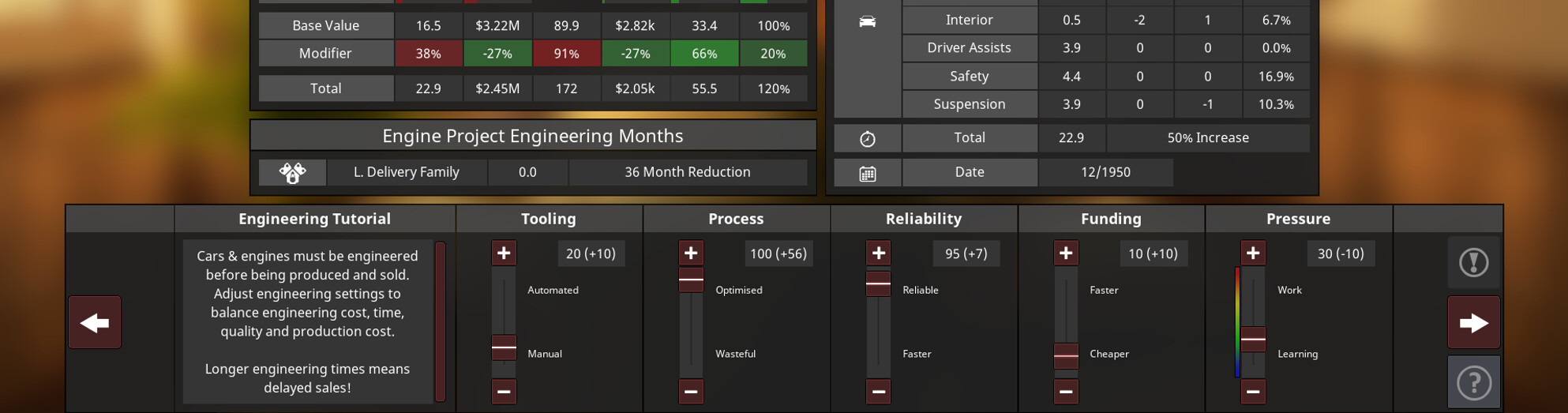
In January 1949, Citizion began a facelift for the Cx100. Tim did not change much for car itself, but in engineering there was much to discuss. For one, Simon mentioned that there was more money available now so Tim could raise the funding slider. This allowed the process slider to be maxed out in-order to maximise the margins. The rest of the points were put into minor improvements in tooling, reliability and process.
image

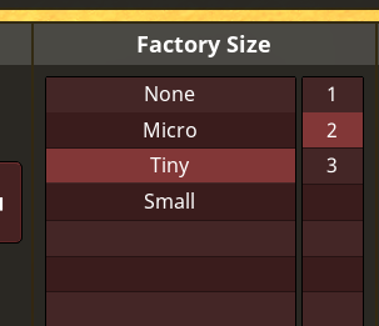
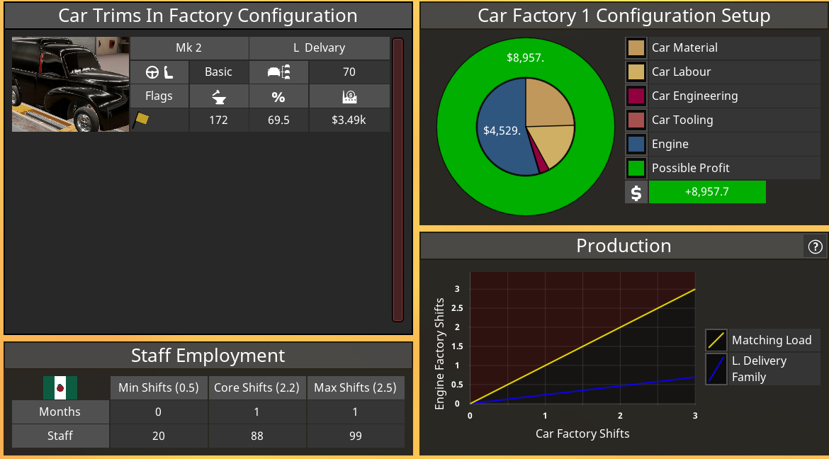
For the factories, Nate made a call to upgrade the first plot to a tiny two because currently Jeff was having to raise the price of the Cx100 by too much to stop the current factories from being overloaded from ever increasing demand.
image

image

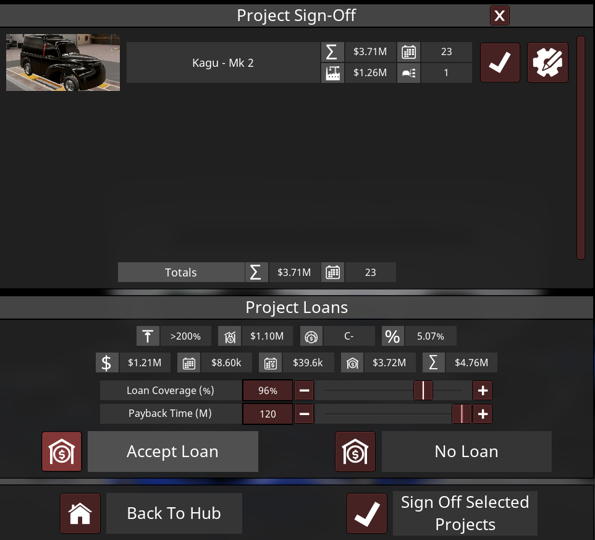
The facelift itself proved to be very costly at 3.71M. But Simon was confident that with the company’s valuation, he could get a loan which would fully pay for it. The monthly coats for this loan are only 40k which would be paid off easily by increased demand.
image

The facelift for Cx100 Took 2 full years until it entered production. When it finally went into production by the end of 1950, Simon worked out that Citizion’s profits rose to 300k a month. By the end of 1951, Citizion had 3.8M in the bank and a valuation of 3M.

Cx100 2nd Facelift

In January 1952, Rob arranged a meeting for the Cx100 second facelift.

Rob: “Alright guys, we now have enough money and factory capacity to add an extra trim to the line up. What should it be?”

Jeff: “Is it the time we branch into family.”

Tim: “Unfortunately no, we can only build utility-based vehicles competitively with coil suspension.”

Pete: “Well utility itself is quite popular at the moment.”

Nate: “That does makes sense, the roads around this part of Fruinia are shit.”

Tim, Simon, Jeff: “Agreed.”

Rob: “Alright that is settled; Tim now you are free to do your magic with the design.”

Tim “Ok”

Rob: “That is it for today’s meeting, thankyou everyone.”
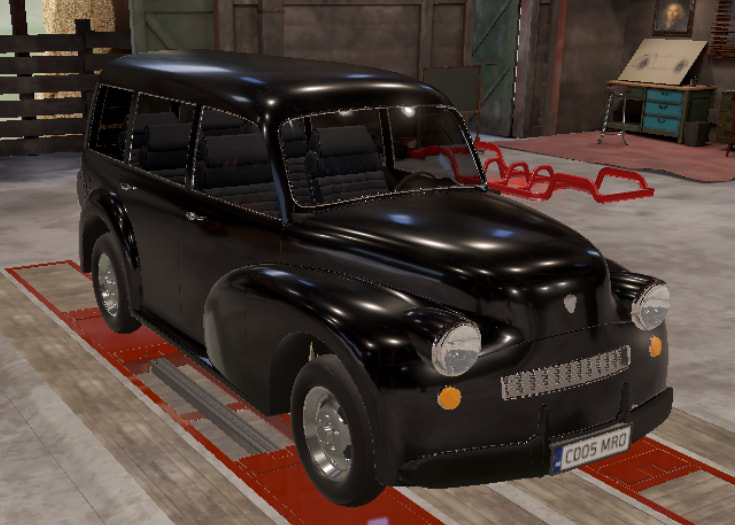
image

image

Part 3 1952-1954

Fruinia’s Emissions Regulations

In 1952, a few months after the production of the Cx100 Utility, Citizion received some news through the post of the barn. When Pete went over to pick it up, the first thing he saw was ’Fruinia to introduce emissions regulations’. He quickly went over to Rob to give him the news. Rob gasped with disbelief. Starting from 1957, all vehicles must at least pass Wes 1. This will increase to Wes 2 in 1962 and Wes 4 in 1967.

Factory Expansion

At the same time as the regulation complication, Nate was monitoring production of the Cx100 Van was which was at 75 units a month. Suddenly he realised since the maximum capacity of our tiny 2 and micro factory was 120 units. This was likely not enough space for the increase in sales of the van and the upcoming utility trim coming in 22 months. “It’s ok”, he said to himself, there is still time to find a new factory. A full 10 months of searching later and Nate finally found a tiny plot with a warehouse in Namilla, which could be converted into a tiny car factory. This would replace the existing micro factory in Costa Guila.

Emissions Test

On January 1953, Pete and Tim took each trim of the Cx100 to the new emissions test facility in Terso. While it was not mandatory yet to take a test until 1957. It was important to check if the cars pass because if they don’t. The team would have to make A Cx100 Facelift to update the engines. When the mechanics were finished with the test, they showed the results. They said that this car was way ahead of its time and would pass emissions as far as 1975. This was amazing news for Pete and Tim, who went home in a good mood.

HQ Expansion

In June 1953, despite all the drama unfolding around Citizion, the Cx100 utitly was released to the public. Simon did his calculations and Citizion was getting £350k gross profit. He quickly went to tell the news to Rob:

Simon: “Hey Rob, how are you doing, Sir?”

Rob: “Very good Simon, I am working on the upcoming sales report on the Cx100 Utility.”

Simon: “Cool, I’ve got Citizion’s finance report from last month and we are earning £350k in gross profit.”

Rob: “Hmmm ok. How much is that compared to our HQ cost?”

Simon: “Well our HQ costs are £50 per month, so it is a 7:1 ratio.”

Rob: “That is above the 5:1 golden rule so I think it’s safe to say we can get an HQ expansion.”

Simon: “Ok, cool, I’ll let the team know.”

Rob: “Ok, thank you very much Simon.”

Simon: “No problem, Sir, bye now.”

A few days later. Rob signs off the paperwork for a addon building to the barn. Construction would begin in July and finish 6 months later in December.

Citizion’s Second Car Platform Meeting

In January 1954, the team had a meeting to discuss Citizion’s second car platform.

Rob: “So folks, what should our second car be?”

Nate, Jeff: ,“Family.”

Nate: “Hey Jeff we finally agree on something!”

Jeff: You! Jeff Gives Nate the DEATH STARE.

Tim: “Ok guys back on point. This branch into family would require us to use double wishbone which we have zero familiarity for.”

Nate: “That’s ok, I have a plan. We do not produce this as a new car but as a prototype first. This way we can build familiarity and then make a facelift to make the car production ready.”

Jeff: “What’s the point?”

Tim: “Well a prototype doesn’t require production so the tooling, process and reliability sliders can be 0.”

Nate: “Which would give us plenty of time to learn double wishbone.”

Tim: “The idea seems reasonable but as soon as we introduce production the engineering time is going to skyrocket.”

Nate: “I reckon if we make tooling and reliability 0 but process 50. Some of the bite is taken away from the production facelift.”

Simon: “This is a more expensive way of making a car. Are you guys certain?”

Nate, Tim: “Yeah.”

Pete: “This could definitely work, but we must make sure the prototype doesn’t take too long.”

Tim: “I will give the prototype a trial first.”

Rob: “That’s great Tim. Although guys this sums up this meeting, thank you everyone.”

C100 Design

Final Car Pics

Test Track

Can be acessed on the Part 3 Video from 8:58.

Part 4 1954-1958

Fusco Releases AU-40. (1954)

In 1954, Fruico released a New Van to the market, the AU-40. It was advertised on the local news paper which eventually made its way to Citizion’s barn. When Pete went to pick it up and look at the front page, he gasped in disbelief. Pete quickly took it up to Rob in his office. He looked at the front page, gave a small nod. As he started skimming through the text, his facial expressions remained unchanged.

Rob: “Cool car, but nothing to worry about. This company’s market awareness is small like ours so it won’t impact our sales that much.

Pete: “But Sir surely the customers will want to know what is the best?”.

Rob: “Well lets give them some stats and then they can decide for themselves.”

Citizion Cx100

Power: 25 Hp

Wheelbase: 2.5m

Cargo: 3530L

Utility: 41

Offroad: 19

Fruico AU_40

Power: 43 Hp

Wheelbase: 2.33m

Cargo 2600L

Utility: 20

Offroad: 35

Citizion vs Safety Regulations (1955)

One morning, in 1955, Citizion received some news through the post of the barn. When Pete went over to pick it up, the first thing he saw was: ‘Fruinia to introduce new bill, Safety standard raises to 25 in 5 years.’ Pete quickly brought the news up to Rob. Rob thought this was unusually high and that Citizion might need to start taking safety more seriously. At around 4:00, Rob went into the design office and asked Tim about the situation. Tim concluded that the Cx100 would need to upgrade to the 60s safety package. He also said Citizion would need to start developing RnD safety to prepare for regulations changes in the far future, as eventually the tech packages themselves would not be enough.

C100 Finishes Prototyping (1956)

In January 1956, Tim has finished the prototype for the C100 and asked the whole team and come and have a look. WOW! Nate in particular was veery impressed with the styling because of featured feminine curves. He also said dark green is a must more distinctive colour which makes it standout. Pete then went through the design with Tim to make sure it meets the brief. Once all was good Rob signed off the prototype and assigned Tim onto engineering, Nate onto factory management and Jeff onto marketing. For engineering, Tim used his experience from the Cx100 and prioritised on making sure Process and Reliability were at decent levels. The end project costs 5M and went on for 23 months.

For factory management, Nate clears out the tiny factory in Namilla so it will be ready to produce the C100. It will also feature an upgrade to Tiny 3. The Tiny 3 in Costa Guila will be upgraded to a Small 1 and now be the only factory to produce the Cx100.

For the Marketing Campaign, Jeff drove the C100 into the Pico Campo mountains. From the peak, he took a picture of the C100 facing the landscape and the ocean. When Jeff finished, he returned to the barn and gathered critical statics from Rob about the C100, including price fuel economy, passenger and cargo volume. 1 Month later, Jeff has finished off the campaign and went over to show the team. When everyone was done with their approval, Rob signed off the marketing campaign and the project for C100.

Citizion attempts to sell to Hetvasia (1957)

In April 1957, Rob makes the decision that Citizion should expand their empire into other countries. The first would be Hetvasia who have a good market for family cars. Rob himself began the long drive with the C100 into Hetvasia where he would make the trade deal. It was colder in this region compared with Fruinia, with average temperatures ranging from 8 to 20 degrees Celsius. It was good that that day Rob remembered to bring a coat, as it was raining with temperatures of 10 degrees outside. When he eventually made it to the site he was welcomed by a very outgoing chap. Rob introduced the C100 and originally the guy was rather intrigued of the styling. But then Rob introduced the specs and the man’s smile suddenly disappeared. He explains that this vehicle is like a death trap to the public. No one would ever buy this because it doesn’t meet the 25-safety standard. He also explained that this was going to increase to 30 in 1960; can the C100 ever meet that? Rob realised during this moment, that this business proposition was done for and it was also a long, cold, depressing journey back home.

#

C100 Public Release (1958)

In January 1958, the C100 was officially released to the public. Over the next month Nate did a factory report and there were 84 units sold for the C100. He also did an update factory report for the Cx100 and there were 205 Units. 36 were Utility and 169 were L-Delivery. Simon also did a report during the same period and Citizion had 20M cash, 16.3M dept and was earning 2.64M from Cx100 and 1.6M for C100. Factoring in the expenses, the gross profit for the company was 1.31M, a great achievement.

Facelift for CX100 and C100 (1958)

In February 1958 Rob arranged a meeting to discuss the upcoming facelifts for Cx100 and C100.

Rob: “Right chaps, it’s about time we do a facelift for the Cx100 and C100 platforms.”

Simon: “We have 20M guys so we can go all the way in this one, we don’t want the tax man biting into us.”

Pete: “Those safety regulations are coming in 2 years Rob so we don’t have much time.”

Rob: “Yes Indeed, Tim did you keep notes on what needs doing for the Cx100 safety?”

Tim: “Yes, I’ve got them here. We need to add a front and rear crumple zone under impact and a steering wheel which collapses under a crash situation.”

Rob: “Fantastic, anything else needed for the Cx100 facelift?”

Tim: “Not really, Vans don’t need much tech. It’s best we continue to refine what we have to improve the reliability tests.”

Jeff: “Yes that is what the Cx100 is marketed as anyway.”

Rob: “How about factories Nate?

Nate: Well, the sales are far from the 280 Max capacity of the Small 1 but I reckon we future proof the factory by upgrading it to small 2.”

Rob: “Well that settles the Cx100 facelift, what about the C100?”

Jeff: “I think we should add another trim, something sporty perhaps.”

Tim: “What?”

Rob: “And why would we do that Jeff? Our entire empire is built upon building cars for the people”.

Jeff: “I think, if you haven’t noticed, every single Fruinia company out there has a race division.”

Pete: “Fusco doesn’t…”

Rob: “We are not making race cars Jeff”.

Jeff: “Hear me out, why not make a family sport as the new trim? This would only require us to beef it up the existing engine and make the car itself more sporty.”

Tim: “Sporty? As in stiffen the suspension?”

Jeff: “Yes, excuse my ignorance of engineering Tim.”

Tim “To beef up the engine, we could just cut bigger diameter holes in the block to increase the bore and stroke.”

Jeff: “See this could work.”

Rob: ”I suppose this trim would plug some of the weakness our company has which is with performance, but it will still be a road car yes Jeff?”

Jeff: “Yeah it should be fine.”

Nate: “Guys there is one small problem with this new trim, our Tiny 3 factory won’t take it.”

Simon: “It’s a perfect opportunity to burn some money on a new plot.”

Nate: “I guess so.”

Rob: “Alright that is settled. Tim now you are free to do your magic with the design.”

Tim: “Ok.”

Rob: “That is it for today’s meeting, thankyou everyone.”
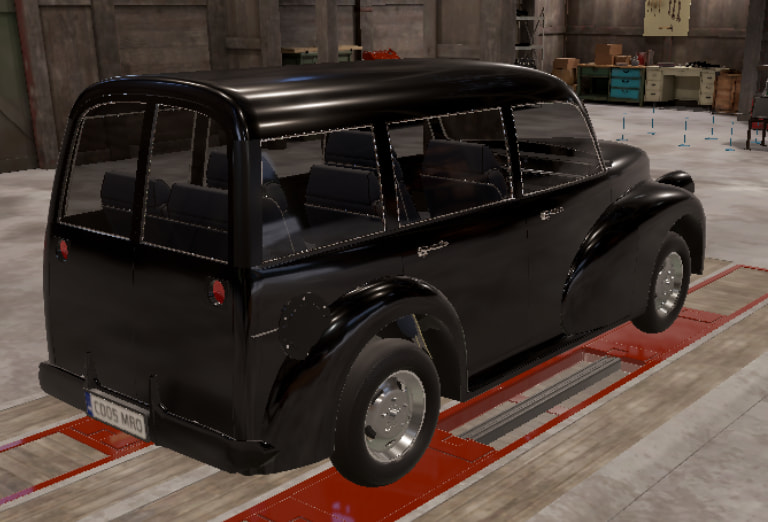
Final Design

1 Like

Part 5

Citizion HQ Relocation (1958)

In March 1958, Rob makes the decision that Citizion would begin the move of the HQ to a larger site. However this also meant he made a difficult decision that the Barn will be eventually put up for sale. This decision was particularly hard on Jeff who’d had this Barn in his family for generations. Despite his best efforts to convince Rob to keep the barn, Rob mentioned that once the new site has been located, the barn would no longer be useful for Citizion. It would be up to Nate to find the new HQ site, which was not easy at first.

For one he could not find anything in Veta and so had to travel further out to expand the search. 2 Months of searching in Raicanta, Paditta, Costa Gulila, Calides, no luck. Eventually he brought his search in and around Terso and struck gold. He found an industrial building site just outside the city with a small car park. It also had big opportunities for expansion in the far future, which means it could be used longer term. In June 1958, the property was officially brought by Citizion but it would take until December until the team officially moved to the new site.

Njord FB-414 (1959)

In 1959 Njord releases the FB-414 into Hetvesia. While the base trim looks like an ordinary sedan, underneath it was anything but ordinary, especially in safety technological advancements. In fact, the FB-414 was so advanced for its time it had a massive impact on the automotive industry. It made headlines in newspapers across the world, some of which eventually made their way across Terso. In March 1959, Tim happened to be walking down the familiar streets and came across a news stand next to a shop. For the first few mini seconds nothing caught his eye, but then he saw a familiar badge. “That’s Njord”. He picked up the paper and had a closer look. The title says ‘Njord to shake the industry with seatbelts.’ The first line of the paragraph says ‘Njord’s FB-414 experiencing price spikes, due to its own success.’ As Tim continued reading, he got an even more of a surprise of the statics of the FB-414 which had 31 safety and the 81 hp out of a 1.8L engine. At around 5:00 when Tim finished shopping, he drove his own personal blue C100 back to HQ where he showed the news to the team.

Wind Tunnel Renting (1959)

In August 1959, Rob takes a stroll around Terso including the university where he once was a student. A lot has changed since he was here 14 years ago, there is a lot more university managed halls. There was also a whole automotive facility, with a test track and a wind tunnel.

In that moment, Rob had a brainwave. Citizion could take advantage of the wind tunnel. He has seen from many newspapers that there is a big push in Fruinia for more aerodynamic designs. Rob formed strong relations with the lectures during his time as a student and it was great that the Head of Automotive Engineering was still there. The very next day Rob turned up for an arranged meeting with the head and discussed the potential for Citizion to work with Terso University. At the end of the meeting, a deal was signed. Citizion would give a 3M Deposit for Aerodynamic research for the university and then a 120k monthly fee. In exchange the wind tunnel would be accessible for any vehicle under the Citizion Brand.

Archana Expansion (1960s)

In 1960, Fruinia officially opens their borders with Archana. They have also allowed car companies the opportunity to import vehicles over. Over at Citizion, Rob decides that in-order to take full advantage of this opportunity, he would arrange with Pete to drive the Cx100 and C100 as a convoy over to Archana to find trading partners. Three months later, Rob and Pete begin the long journey into Archana. The climate is very modest compared with Fruinia with hot summers and cold winters and there was very little rain during the journey, so the land was bone dry. When they eventually made it to the Dealership, they were rather displeased.

Pete: “This place looks like a sweatshop”.

When they went into the building, they were met by a dirty clothed and serious looking chap. It says Kazimir on his nametag.

Kazimir: “What do you want?”

Rob: “Hello Sir, we are here to offer business proposition.”

Kazimir: “If it’s about Dalluha Oil, I am not interested.”

Kazimir is showing his hatred for Dalluha because they got rich from Oil originating from Archana.

Pete: “We are here to offer two cars for you to sell to Archana.”

Kazimir: “Ahuh, let me see.”

Kazimir comes out from his desk and makes his way over to see the cars outside. When they come within sight, his facial expressions suddenly lit up.

Kazimir: “What the F***, you will not find anything this glamorous over in these lands.”

Pete: “Would you like to discuss pricing.”

Kazimir: “First, pop the bonnet.”

Pete walks over to the Cx100 and pops the bonnet.

Kazimir: “A 4 pot! This is serious luxury. Right, let’s discuss pricing, what do you want to sell your cars for.”

Rob: “13k for Cx100 and 12k for C100.”

Kazimir: “Ok the C100 would be possible to sell into Family Premium. But the Cx100 is too expensive.”

Rob: “Ok we might be able to drop the price by 1k.”

Kazimir: “Alright… I’ll discuss this with my manager.”

The guy walks back into the building, leaving Rob and Pete waiting on a decision which could make or break the deal. An agonising 20 minutes later and the guy walks back out of the barn and towards the two nervous faces.

Kazimir: “Right the manger has said………. We have a deal!”

Rob and Pete were relieved that the import deal was a success, and it would be a warm glamorous trip back home.

Meeting for Third platform (1962)

In January 1962, the team had a meeting to discuss Citizion’s third car platform.

Rob: “Right Chaps, what should our third car platform be?”

Pete: “It should be something which we can build multiple trims out off.”

Nate: “GT, Super and Hyper.”

Rob: “We do not need more sporty cars, Nate.”

Tim: “Plus, we are way behind on tyre and engine technology so they would be rather poor quality.”

Jeff: “Convertibles!”

Pete: “Perhaps premium and luxury convertible but bear in mind they are big in Dalluha, not Fruinia or Archana.”

Rob: “That’s ok, Pete, we will just have to go for another business trip.”

Pete: “Rob, you love to make decisions just like that.”

Rob: “Yes sir, someone needs to get the wheels turning.”

Tim: “So, it would make sense for us to develop convertibles as a separate platform because they take a long time to engineer. However, as they are upmarket, we would also need to develop a bigger engine.”

Simon: “We have more enough profit to develop a new engine as well as the car.”

Rob: “So, what engine should we develop Tim?”

Tim: “A V8 Is most suitable if you want the trims to cover convertible premium and luxury.”

Rob: “Alright.”

Tim: “Another thing to consider is the engine will also take a very long time to engineer so we will need to prototype it before hand.”

Nate: “We can do that alongside the car then.”

Tim: “Yes Indeed.”

Rob: “Alright, that wraps up this meeting, thank you everyone.”

Engine Design

Car Design

image

Car Gallery

1 Like