
Description
“Difficult to drive, impossible to beat. That’s a Zacspeed feat.”
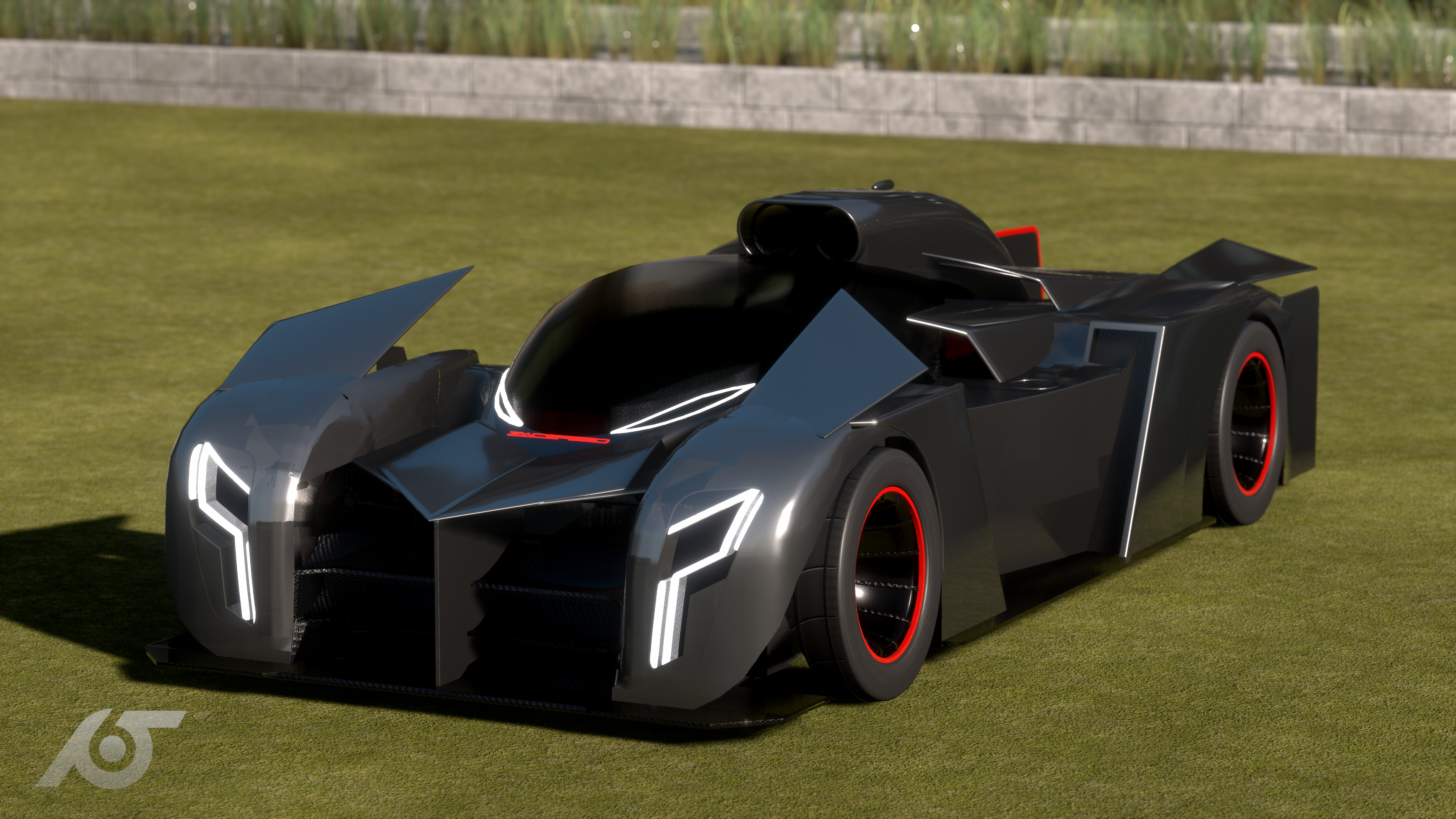
What would an unrestricted Zacspeed look like?
We at Zacspeed tried to answer that ourselves. While a myriad of triumphs, namely the A1GP and X99 Minuteman, spring to mind, the imagination is left wondering whether or not the bounds were pushed far enough - whether there is a new level above the ceiling we so wish to crash through. Thus, we return, lap after lap, wondering where we could press harder; guided by that data, it was our goal to evolving.
This year, however, RZei and GC Soft posed this question directly to us. With the unique working space that is a video game’s environment, we can treat exploring technologies there in a similar vein to testing in the real world. Such information would provide plenty of feedback to us about which concepts could be implemented down the line, even if in a reduced capacity. There was only one way we thought we should do this, and given what the opposition brought to the party, there was only one way we knew we could do this.
Enter Fenrir. This cuckoo hellspawn represents the absolute peak of what we can provide as a company. Derived from our efforts in F1, Extreme Performance Vehicles, and creative wall-throwing, this car pushes the Zacspeed ethos through every ceiling imaginable into the great beyond - space. So absurdly fast is this car that a several-month long program was created for drivers to work their way up to its level of speed, pushing its wielders to superhuman peaks as well.

Perhaps we should start outside with the aerodynamics. Those panels are certainly not for show; four indepently-shifting corner wing panels, in addition to two rudder panels, consist of the active aerodynamic system, while the front is equipped with a multi-element front wing integrated into the bodywork. The rear gets a fan and a revolutionary triple diffuser, two of them being blown by the twin-turbocharged, 4.5L flat-12’s exhaust, while to its sides are Le Mans-style ducting and above it a shark fin. At the sides is a floor touched by the large side vents and front fenders liberated from the main body, where air can escape freely.
The absurd effect this aero kit has on cornering and braking cannot be understated, but that’s not the only party trick this car’s packing. That flat-twelve mentioned earlier is derived from previous motorsport efforts, and in this state of tune, it makes a maximum of 2500 HP while revving to 17000 RPM, leaving viewers with an unmistakable, unfiltered note to be blown away by. This drives the rear wheels, while the hybrid system, of the pneumatic variety, generates an additional 500 HP at the front wheels when charged, leaving to a combined output of 3000 HP. Given the slew of carbon fiber and other lightweight materials in attendance, with weight sitting at 633 kg, the car careens through a quarter-mile in the time it takes some cars to reach 100 km/h, barreling onward to a panel-retracted top speed of 435 MPH.

To further assist with cornering, the cockpit is mounted on rails. Why’s that? Under braking, the cockpit and nose assembly will shoot forward, placing more weight on the front wheels; this new distribution improves cornering. Meanwhile, when accelerating, the cockpit and nose assembly will shift backwards. This is so more weight can sit above the rear tires, which improves acceleration. This is why the engine is flat; it sits low so the cockpit can shift further backward. Speaking of the cockpit, there’s barely any instrumentation. Enter the cockpit as it rises on its single front hinge, and all that stands out, besides some switches and buttons, is a barren F1-based steering wheel, two paddles, and a start/stop switch.
This is where the G-suit comes into play. No human could endure the downforce and yaw force this car develops unscathed, so we developed a suit specifically tailored to each driver and this car’s needs. Its central purpose is to inflate whenever the driver pulls an extreme maneuver, but it also acts as the car’s key. No G-suit plugged in, no start-up. The lack of gauges can be explained by this suit. Its visor makes full use of augmented reality, plugging into the car to provide the driver with every detail they’d expect from gauges and telemetry, including RPM, speed, lap time, fuel, and air tank pressure. Additionally, at the top of their view is what the single rear camera observes, which can be toggled via a physical switch.
Further, the cockpit uses an advanced auxiliary lighting system. Its lights can change from its default color, white, to yellow for improved visibility in inclement weather (fog especially), to red for passing (and intimidation), to blue for indicating a mechanical or electrical fault to the crew team.

Combine all of these elements in one arrow-shaped package, and you’re left with a beast that obliterates conventional rules. Its performance makes one wonder if it’s the air that it’s bending or spacetime. With its extreme speed, even drivers at the top levels of motorsport must adjust as the car’s ferocity of tackling corners can be underestimated, leading to overrunning if timed improperly. New brake points have to be taken into consideration, along with taming any potential wheelspin that could spring from lower speeds.
From this, it can be concluded this car fits the Zacspeed ethos perfectly. Everything done was in the name of performance, leading to a no-frills spaceship bound for record times. However, given the extreme nature of this build, it sits in an exclusive club of the most difficult to drive cars in the series, boiling down to how the driver’s reflexes and timings must be tuned at the atomic level while the car and track must be known cold by the pilot. To do all this unconsciously is the step that separates this car’s masters from its drivers.
Specifications
| 20XX Zacspeed Fenrir | ||
|---|---|---|
| Layout | Mid-Engine, All-Wheel Drive | |
| Chassis | Carbon Fiber Monocoque, Carbon Fiber Panels | |
| Suspension | Front and Rear Pushrods | |
| Brakes | Front and Rear Carbon-Ceramic Discs | |
| Transmission | 7-Speed Dual-Clutch | |
| Weight | 633 kg (1395.5 lbs.) | |
| Engine | 4.5L B12 TT, pneumatic hybrid assistance | |
| Power | 2500 HP, 3000 HP with hybrid assistance | |
| Redline | 17000 RPM | |
| 0-100 km/h | 1.0 s | |
| 1/4 Mile Time | 5.0 s | |
| Top Speed | 435 MPH | |
| 20m Radius Cornering | 3.0 g | |
| 200m Radius Cornering | 10.0 g | |
| Max Cornering | 14+ g | |
| 100-0 km/h Braking | 9m (29.5 ft) | |
| Fuel Consumption | lol | |
Factory Colors
-
Wolf’s Cloak
-
Zacspeed Red
-
Laboratory White
-
Blue Bomber
-
Carbotnik

Acquisition
This car is currently being evaluated by RZei for inclusion in AT6.
Meanwhile, in Racing Ambition, this is rewarded for completing the “Speed Freak” event series, which is structured in the same manner as the proposed training regimen for learning the way of the Fenrir.
Trivia
-
In both games this car debuted in, this is the only car that can outrun the racing line.
-
The panels trigger upon hitting 19 MPH and retract back into the body at 275 MPH
-
This car was initially developed alongside the Zacspeed Fant0m due to indecision concerning which car should represent the company in 6000 Rounds Per Minute. One of its planned gimmicks - the cabin launching forward on slowdown - was the inspiration for the active weight distribution system.
-
The shared development is also referenced in the engine names - where the Fant0m’s engine is called the F04512-TTX, the Fenrir’s engine is called the FB04512-TTX.
-
From a top-down perspective, the car looks similar to an arrow head. Given the word play typically employed in their work, this may very well be a visual pun on the idea of an aero car.
-
The Fenrir is the only Vision car to be shared between Racing Ambition and Automation Turismo.
-
If implemented, this car will most likely be banned from races involving any other Gr.X+ cars in the game. Instead, it may be relegated to its own races against other Fenrirs or simply left to time trials.