
Widowmaker Industries is a controversial automotive manufacturer based in Fruinia, known for experimental engineering, recurring conflicts with regulators and government institutions, and a diverse product range spanning sports cars, luxury sedans and military SUVs. The company survives primarily through niche markets, marketing stunts, public spectacle, motorsport exposure and repeated legal disputes.
The roots of the brand trace back to the 1921 Flugmotorenwerke Fruinia AG (FFAG), a warplane manufacturer specialized in high-performance aircraft engines, which was considered a national champion of Fruinian industrial engineering during the interwar period.
After the son took over and decided to build “a luxury sports car”, he disregarded all logic and planted a leftover aircraft derived V12 into an aluminium chassis. The “Spectacular” was born.
Following a series of fatal accidents and subsequent lawsuits, the press began referring to the company’s 1946 vehicle as (“the Widowmaker”). The nickname gained widespread recognition in the 1950s and eventually replaced the firm’s original name in public discourse and on paper.
The brand’s slogan is the sentence that won the lawsuit regarding the recall of the dangerous 1946 spectacular: “It’s Technically Safe”
Discover the Widowmaker Saga: https://youtu.be/HITV3b89hXY

Origins (Pre-1946)
By the late 1930s, FFAG’s (A Fruinian warplane manufacturer) most successful designs were the V16 Dampfhammer (whose schematics and factories were lost in the war) and the V-12 “ARROW” aero engine (which was later re-used in a destroked version), noted for its high specific output and durability under combat conditions. The long V shape allowed bigger cooling capacity and thus the ability to win and maintain long dogfights. During the war years, FFAG expanded massively, supplying engines for both fighter aircraft and military vehicles, even opening factories in Gasmea. The company gained a reputation for technical excellence, though often achieved under questionable ethical and political circumstances. The founder, the late Johann von Widermacher, a born Hetvesian, was said to have supplied even Gasmean and Fruinian Governments. He retired in 1946, leaving the remaining V12 Engine Factory and a sum of half a billion Fruinian Shekels to his son, who re organized the remaining workforce and company into a Sports Car Production. Some of the workers left in that period and formed their own companies*

Johann von Widermacher
In 1946, von Widermacher retired, leaving the facilities and company resources to his son. Instead of continuing in aviation or pivoting into civilian engines, the heir chose to create an automobile firm — the origin of Widowmaker Industries™.
The Widowmaker Scandal (Late 1940s)
The new Ceo (16years old at the time of takeover) disregarded any practice and started the campaign of his automotive takeover “blind” as he reused old warplane tech instead of learning about car manufacturing.
The first postwar product, the “Spectacular”,

was powered by a heavily destroked version of FFAG’s Falke V-12 aircraft engine. While technically impressive, the car quickly earned a reputation for uncontrollable handling, excessive power, and catastrophic mechanical failures. This large vehicle was infamous for its uncontrollable power and high fatality rate. Alongside it, the company offered a more “family-oriented” sedan, the Adam, which was mechanically similar but marketed as suitable for daily driving. The car was fast and big enough to be famously used in the 1955 Fruinia Bank Heist. One of the Robbers, “Dutch Kassidy” even wrote a letter to the Ceo, thanking him for building a car fast enough to outrun the police.

Within its first year, the “spectacular” was implicated in dozens of fatal accidents. Newspapers dubbed the car “Die Witwenmacher” (“the Widowmaker”), a nickname that rapidly eclipsed its official nameplate.
The situation escalated when Fruinian courts investigated the main factory after a government recall order was ignored (1310 produced cars in the first 9 months were faulty).


The Fruinian Government found out that the Car was not only way too dangerous (200Hp, horrible weight balance, brakes made with aluminium foil, no grip until 100kmh/60mph), but production in general was flawed.
After the company owner tried to escape in a police chase, he crashed into a police car, driving the “widowmaker”.


During one notorious trial, the CEO’s legal team argued that the car was “technically safe,” since the occupant in the high-profile crash had survived. Though the company was acquitted, the proceedings drew international ridicule - but also interest by high society, Moviestars, and young men trying to prove their manhood - sales of the “spectacular” widowmaker soon rose into the thousands. The Lawsuit became the jump start of widowmakers international marketing campaign, attracting young thrill-seekers and film stars alike, who used them as symbols of exaggerated masculinity and public bravado. In the famous movie series about the secret service agent “John Smith”, the “Smith Villain” drives a 48’ Widowmaker.
Full Ep:
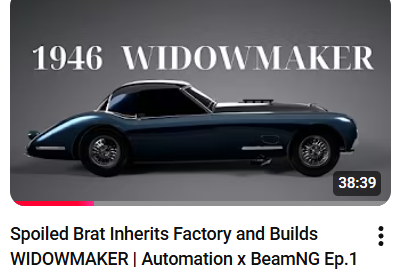 The evidence: https://youtu.be/HITV3b89hXY